Monday, August 16, 2010

China overtakes Japan in 2Q as No. 2 economy

Follow the money. China will overtake the US and its paper pushing activities much sooner than anticipated.

Japan lost its place as the world's No. 2 economy to China in the second quarter as receding global growth sapped momentum and stunted a shaky recovery.

Source: news.yahoo.com

Sunday, August 15, 2010

Connected Money Continues to 'Reposition'

Thanks for posting my email to you Eric...I appreciate the reply....Don't get me wrong ...I appreciate the returns thus far (300 % +). It is that relative to the Price of Gold, I give my head a shake. But as someone recently posted on the Internet, It is Gold that leads the Gold Stocks, not the other way around.

The fact is that there are negative forces around containing the uptrend. They include the media and the powers that see Gold as the antichrist to currency and its unlimited growth trend!

Selim

Gold does provides the leadership, but it is the gold shares that do the heavy lifting. Not only have gold shares provide excellent returns but also increasing dividends since 2000. For the most parts, dividends are excluded from gold stock index returns. A quick review of the dividend payouts from 1920's to 1940's suggests the best is yet to come.

There's an old saying that those that control the gold make the rules. Gold, fixed at $35 - still $42.22 US reserves, used to be controlled with an iron fist. After 1971, its grip loosened substantially. While gold may no longer be "dominated", it's certainly actively managed through media assisted analysis and the paper markets. The paper markets reveal footprints of control not consistent with free and competitive markets.

Connected money is repositioning (withdrawing their shorts) into weakness at the expense of the retail and computer sellers.

Gold London P.M Fixed and the Commercial Traders COT Futures and Options Stochastic Weighted Average of Net Long As A % of Open Interest


Gold London P.M Fixed and the Nonreportable Traders COT Futures and Options Stochastic Weighted Average of Net Long As A % of Open Interest


Take Care,

Eric

Saturday, August 14, 2010

Sword of Damocles Does Not Hang Over the Gold Shares

Hi Eric,

I am curious to find out how you see the HUI playing out from
here in the month of August and early September? Of course it depends on the
price of Gold... Not to mention is sagging Stock Market... But there is a Sword
of Damocles that seems to hang above the poor lonely HUI. The Gold stocks are
still sucking wind over $1200 Gold.

No complaints here.... Just your level headed thoughts.

Selim

Hi Selim,

The Sword of Damocles over gold and the gold stocks has been reinforced by various media outlets since 2000. Yet, despite all the negativity, the gold shares have significantly outperformed all assets during this stretch. Why? Because capital continues to seek safe haven from the more "unofficial" devaluation policies from the official sector.

Martin Armstrong says it best,

NEVER has any government paid its debt. They ALWAYS and without ANY exception default.

By default, Armstrong and the market trends imply devaluation of previously held bonds through inflation. Deflation is only an option if the government intends to repay the debt.

Lots of investors are thinking "the poor HUI (gold stock index). The gold stocks, excluding dividends, have risen more than 300% since 2000, and as have edged slightly above their long-term (30-year) consolidation pattern as of July 2010. A technical breakout will be difficult to refute the longer price and time show strength.

As the calendar turns to August, it is amazing that gold remains in the psychological dog house. Fear, supported by endless spin, allows investors to ignore the incredibly positive seasonal tendencies for gold and the gold shares in August - not to mention fall and early winter. If the first decline after a new purchase is equivalent to a drop down an elevator shaft as often suggested by spin, how many investors will queue to buy?

Risk Free Total Returns* 1926-2010 & 1968-2010:


Source: martinarmstrong.org

Friday, August 13, 2010

Declining Real Retail Sales

> A for payment subscription service that is IMO a must have.
>
> JOHN WILLIAMS' SHADOW GOVERNMENT STATISTICS
>
> SPECIAL NOTICE -- August 13, 2010
> _______________________________________
>
> Retail Sales Hint at Third-Quarter GDP Contraction
> _______________________________________
>
> BRIEF OBSERVATIONS ON TODAY'S DATA. As noted below, posting of the
> full Commentary planned for today has been pushed into this
> weekend. Nonetheless, here are a couple of observations on this
> morning's CPI and retail sales reporting, which respectively were
> slightly stronger and weaker than consensus estimates.
>
> July's rebounding seasonally-adjusted month-to-month 0.31% CPI-U
> inflation (versus down 0.14% in June) and July's unadjusted year-to-
> year 1.24% gain (versus 1.05% in June), partially reflected a swing
> in seasonal factors that now will be boosting adjusted gasoline
> prices for several months. The SGS alternative estimates for July
> annual inflation are 5.4% (1990-base, Pre-Clinton), 8.6% -- 8.57% to
> the second digit -- (1980-base).
>
> The 0.41% seasonally-adjusted monthly gain reported for July Retail
> Sales was statistically indistinguishable from zero growth. After
> inflation adjustment, the real monthly gain was 0.10% percent. Even
> with some upside revision to prior periods, the inflation-adjusted
> July number was below the average for second-quarter 2010. That
> opens up a fair chance of real third-quarter retail sales
> contracting versus the second-quarter, with a suggestion that third-
> quarter GDP could show an outright quarterly contraction, even as
> reported by the government. Full details will follow in the
> Commentary.
>
>
> Best wishes to all, John Williams

Jim

Jim,

Nothing has changed. Devaluation continues to outpace retail sales. In other words, real retail sales continue to decline.

Eric

Gold-Adjusted Retail Sales (RSGLDR) and YOY Change:

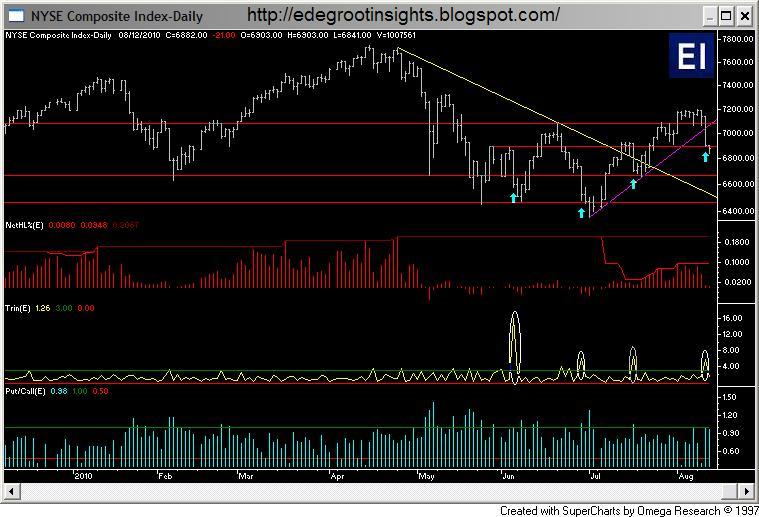
U.S. Equity Market

Trin spike implies a short-term bottom is near.

NYSE Breadth:

Malaysia looks to ancient alternative currency - gold

In a move applauded by some local Muslims, the state government of Kelantan said it was introducing a new monetary system featuring standardised gold and silver coins based on the traditional dinar and dirham coins once used by the Ottoman Empire.

Amazing how gold and silver continue to pull themselves from the "official" monetary trash bin. If you think a standardized gold and silver monetary system will mark the return of monetary Utopia, you probably have heard of the phrase "he got clipped", or the act of coin clipping.

A standardized monetary system must be "flexible" or tied to some measure of international liquidity, or repeat of the Great Depression with confiscation of gold would be inevitable.

Source: blogs.ft.com

Are We Headed for a Lost Economic Decade?

Despite record doses of monetary and fiscal support, the U.S. recovery appears to be stumbling. First-time claims for jobless benefits are on the rise and economic growth estimates for the April-June quarter have fallen to just over 1%. Many are now asking if we are on our way to a double-dip recession or even a Japanese-style "lost decade."

Let me propose two simple observations:

(1) Headed? We're already knee-deep into economic malaise that started in 2000. It's hard to recognize because media driven reality quotes all economic statistics and trends in U.S. dollars. Unfortunately, the U.S. dollar and other major fiat currencies are biased units of measure due to aggressive devaluation. I first talked about this bias in my commentary Dow 10,000 is meaningless. Back in February I suggested the following,

U.S. stocks are denominated in dollars per share. As the dollar continues to devalue, Dow 10,000 today will no longer be comparable. Comparing price levels denominated in debasing (devaluing) currency is like measuring distance from a yardstick that has a quarter inch removed each year. A yard measured today will be two and half inches shorter than one measured ten years ago.

Using similar logic, Dow 10,000 today is no longer comparable to Dow 10,000 of March 1999, because the dollar (yardstick) is not constant over time.

Nothing has changed today, except that the real economic trends have worsened since then.

(2) Lost Decade? When this one is finally recognized as sovereign debt crisis that was fought with currency devaluation, it will have encompassed for more than a decade. My cycle doesn’t suggest real, as opposed to a nominal or biased unit of measure, economic bottom in 2016.

Source: finance.yahoo.com