Monday, April 4, 2011

Fed's Low Interest Rates Crack Retirees' Nest Eggs

A nest egg based on the assumption of stable growth and currency never does well during a debt crisis stabilized by currency devaluation. The unfortunate and cold market reality is either adapt or be left for dead.

Forrest Yeager, a 91-year-old resident of this seaside community, had been counting on his retirement savings to last until he died. The odds are moving against him.

With short-term bank CDs paying less than 1%, the World War II veteran expects his remaining $45,000 stash to yield just a few hundred dollars this year. So, he's digging deeper into his principal to supplement his $1,500 monthly income from Social Security and a small pension.


Source: online.wsj.com

Bull Markets Pronounced Dead In Headlines Well Before the Fact

A nominal bull market will be pronounced dead in the headlines well before the fact. Equity rallies, like humans, tend to show signs of aging before they die. Negative divergences such as price relative to internal market strength often reflect an aging market. The most recent aging signal was generated in 2007.

NYSE Composition and Internal Market Strength Indicators:


Headline: Dos Hombres: Is the Party Over?

Matt Nesto and I hit the Breakout set with a head of steam this morning, fueled by Monday mergers and market tops.

Source: finance.yahoo.com

Silver Transition From Order To Disorder

The backwardation in the silver market reflect unprecedented physical demand for silver. What price relieves the backwardation - $40, $50, or higher? Only the market knows for sure. The trading sharks smell blood and will continue pushing a market stammering on its heels.


Leverage money flows in silver illustrate that all systems, natural or made-made, tend to move from a state of order to disorder. The state of order, market control, used to be shorting rallies and buying the dips. In other words, the diffusion index would rise and fall as price decline and fell, respectively. This distinctive pattern of control has been increasingly "pushed around" by the market since 2010. This illustrates a market in transition.

Silver London P.M Fixed and the Silver Diffusion Index (DI):

Saturday, April 2, 2011

Soaring Dividends During A Debt Crisis Don’t Mean Much

What do soaring dividends in 2011 suggest?

  • The return of investor confidence?

  • The economy is strengthening?

  • Stocks are a good buy?


History says that soaring dividends during debt crisis reflects none of the above. Dividends soared into 1938, yet real (currency adjusted) equity prices did not overcome the 1929 highs until 1958.

Dividend Yield vs S&P 500:


U.S. Large Cap Stocks Capital Appreciation Index (LCSCAI); S&P 500 to Gold Ratio and Z Scores from Primary Trend:


Headline: Dividends come roaring back in 2011
Big companies increased their dividends by a record amount in the first quarter. Since the start of the year, 117 companies in the Standard & Poor's 500 index said they would raise or start paying dividends. The value of the new and raised annual dividends announced by these companies amounted to a record $16.6 billion, according to Howard Silverblatt, senior index analyst at S&P. Just 78 companies raised their dividends in the same period a year ago.

Source: finance.yahoo.com

The Battle To Control The Trend Is Fierce

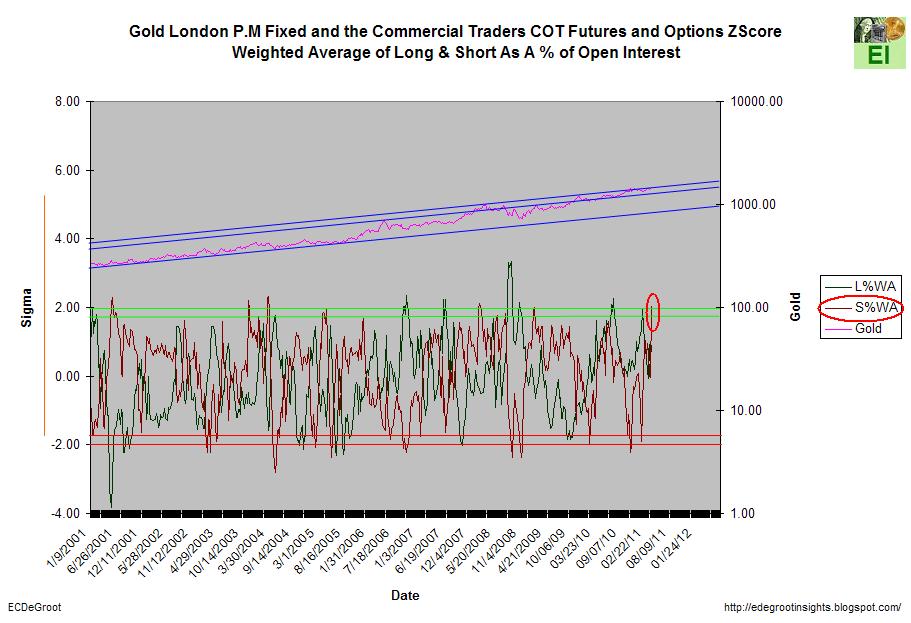
Weakness disguised as strength in the labor market had very little to do with gold’s trading on Friday. A surge in shorts by connected money foreshadowed weakness well before the labor report.

Gold London P.M Fixed and the Commercial Traders COT Futures and Options ZScore Weighted Average of Long & Short As A % of Open Interest


While the public is (re)directed towards meaningless short-term economic noise (i.e. better than expected labor report), they miss what likely be an important technical juncture of the secular advance in gold. The battle to maintain the linear trading channel is fierce. Smart money knows that the computer buying will be difficult to control (dilute with paper supply) once the upper channel is broken. The following chart illustrates the “closeness” of this outcome:

Gold, London P.M. Fixed (Gold) and Z Scores from Primary Trend:


When the parabolic train leaves the station, it will do so with the least amount of passengers as possible.

Silver broke the linear trend first. Gold will follow silver's lead.

Silver, London P.M. Fixed (Silver) and Z Scores from Primary Trend:


Headline: Gold falls after strong jobs report

After ending the first quarter at a new high, gold prices took a hit Friday as investors opted for stocks after a strong reading on U.S. jobs in March.

Gold for June delivery fell $11 to $1,428.90 an ounce at the Comex division of the New York Mercantile Exchange. Gold traded as high as $1,437.80 and as low as $1,413.50 while the spot gold price was losing $4.40, according to Kitco's gold index.

Source: http://money.msn.com/market-news/post.aspx?post=90ed2844-f350-4d85-aa28-95cd990312ed

Friday, April 1, 2011

Gold Is A Product of Debt, Not Business Activity

Jim is absolutely right, debt (and the confidence in the currency that denominates its) drives gold.

Currency devaluation, what the public recognizes as inflation, increases as the debt burden rises.

Debt Cones:


The greater the debt burden, the greater the adjustment in gold. These adjustments, devaluation steps in fiat valuation, influence the price of gold, silver, stocks, bonds, commodities, etc. The last two major devaluation steps in the U.S. dollar are revealed in the following chart:

Devaluation Steps: S&P 500 Total Market Return and Inverse price of Gold


Dear Friends:

Gold is a product of debt, not business activity.
If there was no business and no debt there would not be any interest
in gold.
If there was good business and no debt there would not be much
interest in gold.
If there is over the top Western world debt gold in either good or bad
business gold goes over the top.
If there is a problem with the reserve currency by default and over
Western world debt gold goes over the top, re-enters the monetary
system holding, and 80% of the gain.

Respectfully,
Jim

Source: jsmineset.com

Job Creation Remains Weak

Job creation remains weak despite the attention grabbing headlines. Headline analysis, designed to generate clicks, has a tendency to selectively filter information. A deeper look at the numbers and trends suggests that while the numbers look good job creation remains weak.

(1) The labor force has been contracting year-over-year on a fairly consistent basis since 2009. It posted another annual contraction in March 2011. The contraction (more appropriate described as the reclassification of labor) has helped the official unemployment rate fall from 10.1% to 8.8% between 2009 and 2011.

Civilian Labor Force (CLF) And Year-Over-Year (YOY) Change


(2) Job creation in 2011 remains relatively weak in comparison to the 2003-2008 liquidity expansion. Jobs created from January to March in 2011 lags comparable periods of 2004, 2005, and 2006. A smaller contribution birth/death model, modified in 2011, could explain some of the difference between the periods.

Birth/Death Model (BDM) Contribution to Nonfarm Net Payrolls (NFP) Added/(Lost)


Headline: Unemployment rate falls to 8.8 pct, two-year low

The unemployment rate fell to a two-year low of 8.8 percent in March and companies added workers at the fastest two-month pace since before the recession began.

The Labor Department reported Friday that the economy added 216,000 new jobs last month, offsetting layoffs by local governments. Factories, retailers, education, health care and an array of professional and financial services expanded payrolls.

The second straight month of brisk hiring is the latest sign that the economy is strengthening nearly two years after the recession ended.

Source: finance.yahoo.com