Thursday, September 2, 2010

Silver Attacking Important Resistance Again

Silver is attacking the all important $19.51 to $20.18 resistance zone. This zone reflects the March 2008 and October 1980 swing high and is an important line in the sand that will be vigorously defended in the paper markets. The January 1980 high magnet of 38.25 will be pulling harder once this zone is breached.

Silver, London P.M. Fixed:


As long as trend energy continues to step higher relative to price (that is, produce higher highs than previous readings at a similar price level), it’s only a matter of time before 19.51-20.18 resistance zone is breached to the upside.

Paper Silver ETF (SLV):

Long Term Secular Trends in Small Cap Stocks

The long term secular trend in small cap stocks reflects devaluation through inflation. Similar to large caps, small cap stocks are bounded within a depressionary or devaluation box.

U.S. Small Cap Stocks Total Return Index (SCSTRI):


While small cap stocks outperform large caps within devaluation boxes, they underperform gold.

U.S. Large Cap Stocks Total Return Index (LCSTRI) to U.S. Small Cap Total Return Index (SCSTRI) Ratio:


U.S. Small Cap Total Return Index (SCSTRI) to Gold Ratio:

Wednesday, September 1, 2010

UN: Global food prices highest in 2 years

International food prices have risen to their highest level in two years, fueled in part by a drought in Russia that lifted the cost of wheat, a U.N. agency said Wednesday.

Rising global food prices are byproduct of currency devaluation across the globe. Yet, the headline discussion remains fixed on the message of deflation.

Spot Commodity Prices: CRB Spot Index (1947 - Present);
16-Raw Industrial Spot Price (1935-1947);
Great Britain Wholesale Price of All Commodities (1885-1935)


Foodstuffs, which have underperformed the spot index since 2009, has begun to outperform again. That last time this happened gold accelerated from 2007 to 2008.

Gold and CRBFood to CRBSpot Ratio:


The talk of deflation is nothing more than misdirection away from the message conveyed by the secular trends.

Source: hosted.ap.org

Banks to allow local groups to buy foreclosures

Straight out of the New Deal playbook, public sector funds, better known as ‘free money’, will receive priority over private funds to provide liquidity and help stabilize troubled neighborhoods. Home Owners' Loan Corporation (HOLC) of 1933 was also intended to provide liquidity and prevent foreclosures in troubled neighborhoods during the Great Depression. The HOLC ran out of money by 1935 and had little affect on the secular trends in place since 1929.

Major banks are agreeing to give local governments and nonprofit groups the ability to buy foreclosed homes before they are sold to private investors.

The Obama administration said Wednesday local officials could benefit from acquiring these properties and renovating them or using the land for redevelopment projects. Congress has provided $7 billion to buy the homes, but these groups are struggling to spend the federal money because they are often outbid by speculators who are snapping up foreclosures.

Source: finance.yahoo.com
Source: Top 10 New Deal Programs

Titan Capital Joins Black Swan's Taleb in Raising Bets on Crash

The Final Pillar of the Gold price at $1650 is US government long bonds

Jim

Jim,

In US dollar terms, yes, the US government long bond market is the final pillar to fall.

Five Golden Pillars:


All charts have been updated through August 2010.

Long-Term U.S. Government Bonds Total Return Index (LTGBTRI):


In a multi-dimensional world, where capital flows recognize the effects of currency devaluation, the US long bond market has already generated a recognizable top in constant currency terms - gold. The long-term U.S. Government Bond Total Return Index to Gold ratio recognized a top in 2002.

Long-Term U.S. Government Bonds Total Return Index (LTGBTRI) to Gold Ratio:


Capital (flows), unlike headline analysis, is neither blind nor stupid. The higher order deceleration in the bond market's secular trend is mirrored by higher order acceleration in the gold market's secular trend. This is market by the red and blue parabolic curves above and below.

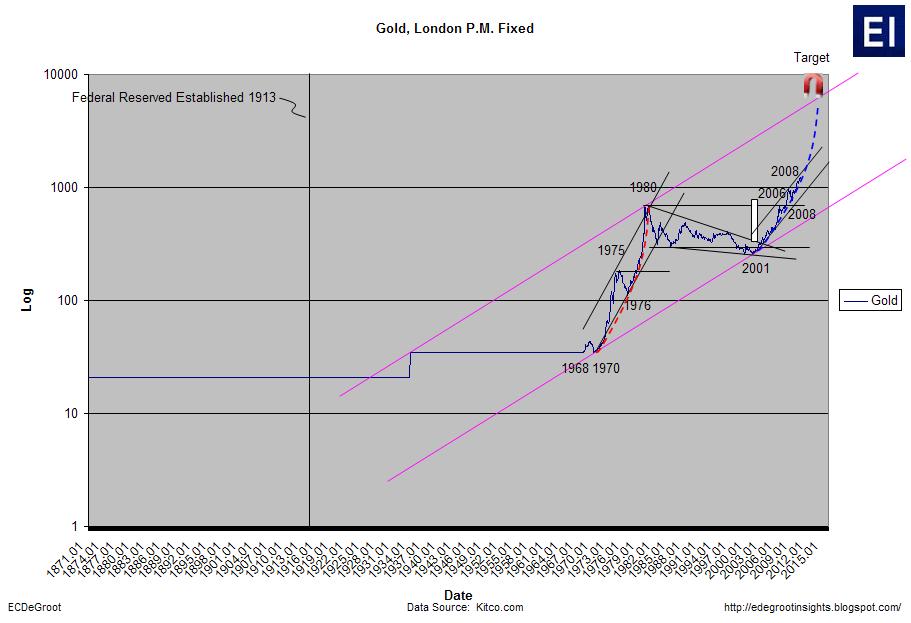
Gold, London P.M. Fixed:


The breakout in the gold stocks suggests that it is happening here and now.

S&P Gold (Formerly Precious Metals Mining)*
*S&P Gold from 1945, Barron's Gold Stock Index from 1939-1945, 1922-1939 Homestake Mining:


Stick your head in the sand if you like. I only suggest that if you do, you might not like what you see when you pull it out.

Regards,

Eric

Nassim Nicholas Taleb, whose book “The Black Swan” is about how unforeseen events can roil markets, said Aug. 11 he is “betting on the collapse of government bonds” and that investors should avoid stocks. Government bonds around the world have rallied on growing signs the global economic recovery is faltering, driving yields on two-year Treasury notes as well as German 30-year and 10-year bonds to record lows last week.

Source: bloomberg.com

China may probe BHP's bid for Potash: report

The consequence of an economic battlefield, battle for resources and control, that not only knows no boundaries but also allegiances.

China may launch an antimonopoly probe into BHP Billiton's $39 billion bid for Canada's Potash Corp, the China Business News said on Wednesday, citing a source familiar with the matter.

China will also review the merger of two Russian potash firms -- Uralkali and Silvinit -- given the major impact the two deals would have on China, the paper cited the unnamed source as saying.

Source: finance.yahoo.com

Japan debt safer than U.S. debt: China economist

One thing is for sure. Rumor or not about the Chinese Central Banker, you can be sure that the people who run the Chinese central bank will not buy many more US Treasuries. Yes, this statement speaks to the Chinese rating of US Treasury investments, a definite downgrade THAT MOODY'S AND STANDARD & POORS DARE NOT MAKE.

Jim


Jim,

Agreed.

The downgrade of US debt would be considered a national threat. It's interesting that Japanese debt, a country also using massive currency debasement relative to gold to mitigate its enormous debt burden, would be considered 'better' than the US.

Eric

China has been buying record amounts of Japanese government debt because it is less risky than U.S. debt, at least in the short term, a Chinese government economist said on Wednesday.

Investing in Japanese bonds is safer because so much of the country's debt is held domestically, and the yen is on course to strengthen further, said Zhang Ming, an economist with the Chinese Academy of Social Sciences, a top government think-tank.

Source: newsdaily.com