Wednesday, June 30, 2010

The Illusion of Fiat

While the talking heads sell the strength in the U.S. dollar via the U.S. dollar index as a destination for safe haven capital flows, they ignore the reality that it's value represents relative and unbalanced comparison against only fiat money. The world's premier currency - gold is completely ignored. Any comparison to gold would break the illusion so easily sold to the public.

U.S. Dollar Index:


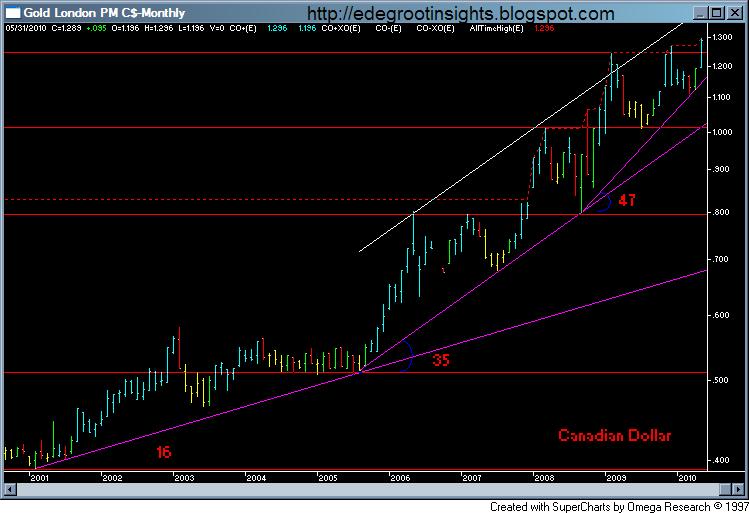
The safe haven status of the dollar is an illusion based on the premise that it is the best of the worst within a fiat system. When components of the U.S. dollar Index are compared against gold, the sharp, accelerating up trends reveal the extent of the illusion.

U.S. Dollar Gold:


Euro Gold:


Yen Gold:


Pound Gold:


Canadian Dollar Gold:


Swedish Krona Gold:


Swiss Franc Gold:

Nearly 1 in 3 first-quarter home sales a foreclosure: report

As the report suggests, this is a significant number that reflects the extent of the distress in the real estate market.

Nearly one out of every three U.S. home sales in the first quarter was a foreclosure property as steep price discounts boosted demand for distressed real estate, RealtyTrac said in a new report on Wednesday.

Foreclosure homes accounted for 31 percent of all residential sales in the first quarter of 2010, with the average sales price of properties that sold while in some stage of foreclosure nearly 27 percent below homes that were not in the process, Irvine, California-based RealtyTrac said.

"In a normal market, only 1 to 2 percent of home sales are foreclosures, so this is certainly a significant level," Rick Sharga, senior vice president at RealtyTrac, said in an interview.

Source: finance.yahoo.com

Fixing Housing Crisis: Time To Scrap the 30-Year Mortgage?

Outdated is an interesting adjective. The long-term mortgages, which began as a Depression-era remedy to keep Americans in their homes in the 30's, serve the same purpose today. Many Americans, probably a lot more than will ever be officially recognized, cannot afford short maturity mortgages. Simply put, many Americans cannot afford to be home owners. It's all about affording the payment. Paying off the loan, as suggested by the increasing number of strategic defaults (walk-a-ways), is secondary.

The long-term mortgage, which began as a Depression-era remedy to keep Americans in their homes, may be out of step, given the current housing crisis.

Could it be time to say good-bye to the popular 30-year mortgage?

"The 30-year mortgage is outdated, the standard fixed-rate mortgage is outdated, and it has to be improved," housing expert Robert J. Shiller told CNBC.

Source: finance.yahoo.com

Sectors Relative Strength Analysis

Sector relative strength analysis not only reveals market leadership (or lack thereof) but also the underlying drivers of the stock market trend. I find relative strength analysis an important and critical tool that reveals the complexion of the trend.

In my June 27th commentary, I suggested that the gold shares were displaying dominant relative strength.

The following charts, displaying sector relative strength to both stocks and gold, clearly illustrate this dominance.

Relative Strength to U.S. Stocks:


Relative Strength to Gold:


On May 19th I implored investors to stand your ground, or face the big boot upon resolution of this breakout. The big boot still waits at the end of this breakout for those that cannot withstand the headline fear.

Big Boot:

Gold ETF Swells To Pass $50 Billion Milestone

The Gold ETF is an excellent conduit to redirect physical demand into paper. The Gold ETF is similar to a fractional reserve bank. As long as customers don't fear for their money, the bank can service the cash demands for a small percentage of its customers. A run on the bank develops when too many customers request their cash at once. A large ETF holder, fearing for the return of their gold, will demand delivery as stated in the prospectus at some point. If the fear spreads beyond a small group, a run on the ETF will occur. Unfortunately, unlike banks, there's no such thing an ETF holiday, or Federal Deposit Insurance Corporation. The market price and revised investors expectations towards its holdings will be quickly discounted into the share price.

Amid all the market doom and gloom, the world’s largest gold fund is quietly celebrating another major milestone: SPDR Gold Shares, an exchange-traded fund backed by physical bullion, has recently surpassed $50 billion in assets.

Source: blogs.wsj.com

Senate combines jobless benefits, homebuyer credit

Where there's a will, there's a way. Additional stimulus is coming.

Senate Democrats are working on a new way to jump-start their stalled election-year jobs agenda while saving unemployment benefits for hundreds of thousands of laid-off workers.

The plan is to create one bill that combines the unemployment benefits with an extension of a popular tax credit for people who buy new homes.

Source: finance.yahoo.com

Tuesday, June 29, 2010

U.S. Stocks Observations

It’s easy to be bearish right now. Stocks are clearly struggling on critical support.

Couple observations:

(1) A minor cycle date is 06/30/10. When time is “up”, price tends to reverse in the opposite direction. Minor cycle dates are not as influential as major cycle dates.
(2) The energy of the decline, contrary to the hype, is weakening rather than strengthening. This can viewed from the S&P 500 with exchange volume chart. The flash crash (5/6) low was created 2.57 billion (B) shares. This low has been tested three times on 1.9 B, 1.64 B, and 1.6 B shares. This suggests waning downside energy.
(3) Many technicians suggest that there’s no such thing as triple bottom. If that is case, then I am not certain what to call the setup in 2002-2003. See chart below.

S&P 500 with exchange volume:


S&P 500 2002-2003


Does any of this suggest that I am bullish on equities? No. Gold continues to outperform equities by a wide margin and remains the better devaluation hedge.

What might come as a surprise to the bears is how equities perform as devaluation hedge despite putrid business conditions. For example, while many predict Dow 5,000 and gold $2,000, history suggests that Dow 12,000 (or higher) and gold $5,000 (or higher) is more likely under a fiat currency system.

Mailbox: Hyperinflation & The Weimar Experience

1/ The type on inflation being discounted by Gold requires business activity to be putrid.

2/ This type on inflation is hyperinflation, which is a currency event, not an economic demand phenomenon.


Confidence in fiat, similar to the early stages of the Weimar experience, is eroding. Gold and to a lesser degree stocks are beginning to reflect the accelerating loss of confidence.

It was the devaluation of the Mark (fiat) and the erosion of confidence entrusted to the custodians of it that forced Germans to seek protection in stocks and gold despite putrid business conditions. Money seeking refuge from the devaluation flowed into stocks and even more so gold. Those that failed to recognize the trend (and their drivers) were financially ruined. These capital flows are illustrated in the following chart:

Weimar Hyperinflation Experience:


Markets Make A Definitive Statements

Equity markets sharply lower. Euro sharply lower. Commodities under significant pressure. Gold opens lower and recovers $16 from the low to be up on the day.

1/ The type on inflation being discounted by Gold requires business activity to be putrid.

2/ This type on inflation is hyperinflation, which is a currency event, not an economic demand phenomenon.

3/ Rather than a singular currency loss of confidence igniting hyperinflation, it will be all Western currencies moving against each other with intolerable, to business, volatility.

4/ All Western governments will practice QE to infinity, as we return to credit market problems. The statement of the G 20 and Prince Charles cutting down on caterers is all smoke and MOPE.

5/ Gold is NOT a commodity.

6/ Gold is a currency

7/ Gold is the currency of choice.

8/ Gold is going to becoming the reserve asset of choice by central banks

9/ Ownership of gold means you are your own central bank.

Conclusion:

The arguments between inflation and deflation revealed itself today to be purely semantical.

Gold is headed in this move to $1650 with its normal drama.

State pension system near collapse

Inaction can be tolerated for only so long. Remember when the Fed tried to convince everyone that quantitative easing programs could be scaled back? How long before Stimulus III (possibly IV) become absolute necessity? Austerity and deficit reduction after high profile and public bailouts won't last long when unemployment lingers and climbs higher.

"New Jersey's defined pension systems are underfunded by more than $170 billion, an amount equivalent to 44 percent of gross state product and 328 percent of the state's explicit government debt," said authors Eileen Norcross and Andrew Biggs.
The report says the state has five defined benefit pension plans that cover 770,000 public workers, and more than a quarter million retirees depend on $6 billion per year in benefits.

Officials maintain pension plans are underfunded by $44.7 billion when the return on investment is 8.25 percent. The study used calculations consistent with private-sector accounting methods and, when they are applied, the state's underfunded benefit obligations go from $44.7 billion to $173.9 billion.

"It is estimated if state pension assets average a return of 8 percent, New Jersey will run out of funds to meet its pension obligations in 2019. If asset returns are lower than 8 percent, they will run out of funds sooner," the report says.
How much sooner?

Under certain assumptions the well could go dry as early as 2013.

Source: app.com

Monday, June 28, 2010

Prepare for Cliff-Edge, 'Monster' Money Printing: RBS

Monster quantitative easing, suggesting higher gold prices and bond yields, or essentially a prediction for a major loss of confidence in fiat money.

'Monster' Quantitative Easing Coming

Roberts is predicting the central banks are going to have to start pumping more money into the system.

"With fiscal policy off the agenda, we have always expected more quantitative monetary easing," he wrote. "And this time will be different. We have always argued that buying of bonds is less efficient than guaranteeing yield levels, and that yields are the key, not raising money supply, given demand for credit is dead."

Source: cnbc.com

US State Budget Crises Threaten Social Fabric

The reality of austerity and balance budgets in the face of an international debt crisis. The same thing happened in the Great Depression. The unemployment rate surged to 1 in 4 before austerity was abandoned for devaluation and the equivalent of today's quantitative easing. Keep this in mind when G-20 nations pledge to cut deficit spending in half by 2013.

The small southern California city of Maywood has hit on a unique solution to its budget crisis. Crushed by the recession and falling tax revenues, the city is disbanding its police force and firing all public sector employees.

Maywood has opted for an extreme solution, by contracting out all public services, including the most basic, to save cash. But it is not alone.

Source: cnbc.com

Mailbox

Hi Eric,
I've just watched gold get taken down $18 in 20 minutes or so. And I'm thinking - what's to stop the cartel/bullion banks from just using the trillions of dollars to cap the price?

It seems like cycles don't matter - they just take it down when they want. You almost question why bother with it all.

Just speaking out of frustration. I want to believe in a upside price blast, but all I keep seeing is price take downs.
A


Predictable, engineered take down after a G-20 meeting. As I have already written, intervention against the primary trend is always fleeting.

If the central bank and their bullion agents had complete dominance (control) over the gold market, it would not be appreciating faster than stocks, bonds, real estate, etc. since 2000. If gold is a barbaric relic, as often suggested, why is the price of gold quoted and accepted across the world? Furthermore, why do centralize powers remain so secretive about holdings and transaction intentions? Don’t let experts override your investment intuition and logic.

Gold, scare and portable, has been and continues to be an important monetary metal with the key distinction that it carries no liability in a world inundated with interconnected liabilities.

Make no mistake, gold is gaining ground. If you, as well as all within the community, maintain your wits while all others lose them, declines are gifts for further accumulation.

By the way, cycles do matter. No amount of intervention can reverse cycles. While intervention can oscillate markets around major and minor cycle dates, they cannot, regardless of size, reverse secular trend or invert cycles. Cycle inversions, while rare, are cause by capital flows or competitive market forces.

Regards,

Eric

Paper Gold

Today’s (G-20 engineered) declined probes 6/17 gap support and is meant to smash growing confidence in gold. Fiat money is a confidence game. Growing confidence in gold, or waning confidence in fiat, is not in the best interests of G-20 nations. Any test of support, either 6/17 gap or the rainbow of gaps below, on light volume would be a bullish setup.

Intervention against the secular trend cannot be maintained for long. Remember that when F-TV and select F-TV guests scream top yet again.

Gold ETF (GLD):

Consumer spending, incomes edged up last month

Consumer spending rose slightly in May, as Americans remain reluctant to open their wallets amid a slow economic recovery.

I'd hardly classify a personal consumption to income ratio at 84.6%, slightly off the all-time high of 85.1% in March, as reluctant to spend. Spend-a-holics at the expense of savings comes to mind.

The key to any economic recovery, something understood by the Chinese, is investment in future plant, production, and equipment. It's the I of GDP = Consumption + Government + Investments(I) + (Exports - Imports) that increases future GDP.

Personal Consumption As A % of Personal Income:


Source: finance.yahoo.com

Deficit hawks score points at G-20

Does anyone read this stuff? Listen, anyone following austerity measures intended to cut deficits and strengthen balance sheets will repeat the early mistakes of the Great Depression. Talk for the cameras is cheaper than cheap. Devaluation and quantitative easing must continue or unemployment will climb to levels not seen since the Great Depression.

Leaders of the world's most important economies agreed to ambitious targets for getting deficits under control, pledging to cut them in half by 2013, according to a statement made following the G-20 summit this weekend in Toronto.

Source: money.cnn.com

Sunday, June 27, 2010

Gold Shares Dominant Relative Strength

Gold shares post their highest close relative to the stock market since the onset of the bull market in 2000. The gold shares sector continues to be the strongest group within the stock market. This is characteristic of a devaluation-driven economic environment.

Gold Miners Index to S&P 500:

Consumer sentiment highest since Jan 2008

Consumer sentiment rose in June to its highest since January 2008 while reports of job losses were down sharply from a year ago, a survey showed on Friday.

A gauge of current economic conditions also rose to its highest since January 2008, according to the Thomson Reuters/University of Michigan's Surveys of Consumers.

Be wary of positive news from "soft" (survey & sentiment) indicators. This is the third counter trend rally since the secular down trend started in 2000. Once the bounce is over, it will setup the next decline in confidence and rally in gold. The counter trend rally since 2009 is similar to the setup of 1975-1976.

University of Michigan Consumer Expectations (CE) and Gold: A Correlation Study:

Saturday, June 26, 2010

Iran on war alert over "US and Israeli concentrations" in Azerbaijan

Out of mind, but not out of sight of the markets.

In a rare move, Iran has declared a state of war on its northwestern border, debkafile's military and Iranian sources report. Iranian Revolutionary Guards Corps men and equipment units are being massed in the Caspian Sea region against what Tehran claims are US and Israeli forces concentrated on army and air bases in Azerbaijan ready to strike Iran's nuclear facilities.

Source: debka.com

Crude (Oil) Reality

Inflows, similar 2003-2004, will likely setup the next devaluation driven leg up.

Crude Oil (WTI) and the Commercial Traders COT Futures and Options Stochastic Weighted Average of Net Long As A % of Open Interest:

Minor Cycle Date Approaches for U.S. Stocks

Headlines selling fear into decline tend to corrupt discipline. The mind begins to wander. What do they know that I don't?

Price continues to flirt with October 2009 support zone. This indecisiveness only augments the anxiety during recent price chop.

S&P 500 with Exchange Volume:


The decline into fear continues to be quietly faded and embraced by connected and retail money, respectively. In other words, retail money, or the small player is taking (selling) this decline hook, line, and sinker. These opposing money flows, connected in and retail out, represent a unique, multi-time frame bullish setup that is revealed in the following table.

COT Money Flow Table:


Capital continues to flee Europe towards the safety of gold and US capital markets. If fear subsides into the minor cycle date, a subtle reallocation from bonds to stocks has the potential to send stocks higher into the approaching major cycle date. Headlines selling fear ignore this potential outcome.

Friday, June 25, 2010

Ben Bernanke needs fresh monetary blitz as US recovery falters

One does not ascend to the position of Chairman and members of the board without an understanding of economic history. What is implied can be best characterized as pick your poison. Choose devaluation and reduced purchase power for everyone using fiat money, or risk an intensified economic contraction that will send real, not statistically massaged, unemployment to level not seen since the Great Depression.

Unemployment Rate:


Key members of the five-man Board are quietly mulling a fresh burst of asset purchases, if necessary by pushing the Fed's balance sheet from $2.4 trillion (£1.6 trillion) to uncharted levels of $5 trillion. But they are certain to face intense scepticism from regional hardliners. The dispute has echoes of the early 1930s when the Chicago Fed stymied rescue efforts.


Source: telegraph.co.uk

States of Crisis for 46 Governments Facing Greek-Style Deficits

46 States and growing.


Californians don’t see much evidence that the worst economic contraction since the Great Depression is coming to an end.

Unemployment was 12.4 percent in May, 2.7 percentage points higher than the national rate. Lawmakers gridlocked over how to close a $19 billion budget gap are weighing the termination of the main welfare program for 1.3 million poor families or borrowing more than $9 billion in the bond market. California, tied with Illinois for the lowest credit rating of any state, is diverting a rising portion of tax revenue to service debt, Bloomberg Markets magazine reports in its August issue.

From my June 22 Commentary, Gold, The Formula and Illusion of Recovery.

I know much of the media and many individuals have filed the structural deficit under "Who Care's" and moved on. It is, nevertheless, very important to confidence in and fate of the U.S. dollar. Total revenues collects by the US government continue to lag devaluation in the US dollar. In other words, "real" or gold adjusted total revenues continue to collapse at an alarming rate.

Source: bloomberg.com

From Card Fees to Mortgages, a New Day for Consumers

Some details on the extra "protection" intended to save us all from the next crisis - until the next crisis reveals that the old rules didn't help.

While elected officials spent much of their time working out the details of regulating complex derivatives and grappling with whether banks ought to make big bets with their own money, they also set a number of new rules that will directly affect consumers.

Source: finance.yahoo.com

House, Senate lawmakers finalize deal on bank bill

This removes the "Too big to Fail" from American financial lexicon? Nope. The global financial system is too interconnected. A derivative written, regardless of its origin, influences the entire global financial system through interconnected counter party risk. If one part of the daisy chain goes, the entire system will still be affected. One solution is to standardized, list, and clear all derivative trading. Bear in mind that standardization carries numerous drawbacks and little support from powerful interests.

Lawmakers shook hands on the compromise legislation at 5:39 a.m. after Obama administration officials helped broker a deal that cracked the last impediment to the bill -- a proposal to force banks to spin off their lucrative derivatives trading business.

Source: finance.yahoo.com

Thursday, June 24, 2010

Technical Review - Gold Miners Index

The gold stocks have and continue to lead the stock market. This leadership, in and of itself, reveals the troubling nature of the devaluation driven economic recovery and stock market rally.

The 2008 congestion zone is currently being tested for the third time. This is important because the three taps and out heuristic is designed to remind us of the cyclical nature of supply and demand relationships.

With that said, it is so easy fall victim to fear with so many yelling fire in a crowded theater. These are the times when the media outlets inflect the greatest damage to discipline and portfolios.

The colored zones below price illustrates strong support for the gold stocks regardless of the depiction of fear. Weakness into the minor cycle low is hardly bearish for the gold stocks. Decreasing energy into the zone and minor cycle date would provide a bullish setup for gold stocks. When time is right, price will follow.

Gold Miners Index ETF (GDX):

Deutsche Bank: U.S. Financial Conditions Just Collapsed Back To Crisis Levels

Back towards to Crisis levels. How about worse than recent crisis levels in this, The Ski Jump Virtual Recovery.

Jim


Credit conditions or liquidity are once again tightening (spreads widening) as the economy is loosing momentum from waning stimulus. Watch out. This is a precursor for trouble, which usually means more stimulus.

Commercial Paper 90 days less Treasury Bill 90 days:


Deutsche Bank has a new and improved index of U.S. financial conditions, and this index just slumped back towards the lows of our recent crisis.

Source: businessinsider.com

As Goes Housing So Goes Stimulus

The end of the Federal homebuyer tax credit in April slowed down Lennar Corp.'s May results and hurt fiscal second-quarter revenue, but the homebuilder reversed a year-ago loss as it cut costs.

The pressure to resume programs that support housing intensify as market trends deteriorate.

New home sales drop to lowest level since the inception of the series.

New Home Sales And Change YOY, SA:


The price of lumber has fallen below the October 2009 lows. Connected money has been fading the weakness but not enough to generate a statistically significant, bullish setup.

Lumber Futures Continuous Contract and the Commercial Traders COT Futures and Options Stochastic Weighted Average of Net Long As A % of Open Interest:


The consolidation pattern within the downtrend has been broken to the downside in the Housing Index.

Housing Index:


Source: finance.yahoo.com

Wednesday, June 23, 2010

5-Year Treasury Auction Trends

No change in participation trends. Direct bidders continue to represent an increasing portion of the accepted bids since 2009.

5-Year Treasury Auction Trends


Source: treasurydirect.gov

Mailbox

Some good observations from Bob

People talk about cycles and super cycles as if they occurred out of nowhere. They all happen by design. As an example, the economy has improved, but that is because of $800 billion in stimulus and Fed spending. The growth that evolved was tepid at best. Now that the economy is trailing off, the stimulus having expended itself, and the question is what comes next? The only way to stave off recession/depression is to have another stimulus plan. That, of course, doesn’t affect the root causes - it just gains time.

Source: theinternationalforecaster.com

New-home sales plunge 33 pct with tax credits gone

How long before the program resumes?

Sales of new homes collapsed in May, sinking 33 percent to the lowest level on record as potential buyers stopped shopping for homes once they could no longer receive government tax credits.

New Home Sales And Change YOY, SA:


It's hard to be bullish on real estate when real gold adjusted home prices continue to decline.

Mediam Home Price to Gold Ratio (MHPGOLDR) And YOY Change:


Source: news.yahoo.com

This is NOT the end of the Gold rally

With the onset of every reaction in gold the chorus of "this is the end" across the trading floors and high speed switches of the Internet.

Trust me, the end will come in the form of a public mania. John Q. Public, the man on the street, will be checking gold prices daily on their handheld devices and shop store windows across the country and globe.

This is not the end but rather a "purely coincidental" reaction during a Fed meeting that has been repeated too many times to count. The a rainbow of colors, previous resistance zones, will now be tested as support. Watch for bullish setups once this paper operation ends.

Paper Gold ETF (GLD):


Turn off the TV, watch US Football (soccer), and for those that need "this is the end", listen to The Doors.

This is the end
Beautiful friend
This is the end

The End, The Doors 1967


Source: lyricsfreak.com
Source: youtube.com

Soros says Germany could cause euro collapse

The Euro is acting like gold is the Great Depression. The US could not devalue the U.S. dollar under the gold standard. Gold was confiscated and revalued, against the wishes of nearly all central bankers at the time, in order to devalue the U.S. dollar.

The Euro, defined by its construction, is acting like gold in the Great Depression. It is forcing austerity and preventing the Euro from devaluing. As a result, Germany begins to export deflation to it trading partners. Which in turn, exports deflation to the US and countries pegged to the U.S. dollar (i.e. China).

Would Germany be responsible for destroying the Euro Zone? As long as the Euro maintains austerity rather than infinite quantitative easing (QE), tension and the blame game will continue to rise. It will be these forces that will tear the Euro zone apart regardless of who carries the label of blame.

"German policy is a danger for Europe, it could destroy the European project," said Soros, who earned $1 billion in 1992 by betting against the British pound.

Source: finance.yahoo.com

Silver - Monetary or Industrial Metal?

Hi Eric,

I have enjoyed your insights while reading Jim Sinclair website. He often says silver is a game but that it may rise a higher percentage than gold. With deflation and inflation (hyperinflation) occurring possibly at the same time, what do you think will happen to the prices of silver coins (example: Morgan silver dollars) in a failing economy? Will prices of rare coins rise with the price of silver, or will it fall in relative value since not many can afford it? I would appreciate your thoughts since Jim always recommends an exit strategy. Thanks,

CIGA Ralph

Ralph,

Silver best described as a “game.” It is a game that entails both monetary and industrial characteristics. Silver has become increasing scare for industrial usage and sought for protection against devaluation. What Jim and I have discussed is that silver has the potential to display surprising monetary demand from a public unable to buy and/or afford gold. The potential for unexpected demand with tight supplies can only describe a trend with explosive potential energy.

We are seeing debt deflation that would normally cause monetary deflation under a fixed gold standard. 1930’s style deflation (increasing demand for money), however, is unlikely under the fiat system and the predictable reaction of governments for self-preservation. I know this is a hot debate, but honestly, many of the debaters do not understand the mechanics of money well enough to discuss them correctly.

In a failing economy, it will be the response from centralize control the affects the price of silver. Fear about holding silver (and gold) are based on the assumption that a failing economy would illicit no centralized response. Self-preservation and maintenance of the status quo is and will continue to be the basis of policy formation for years to come.

There will be a time to sell silver, but that time is not now. Reintegration of silver into the monetary system, while possible, is not likely. This makes silver a game relative to gold. The exit strategies will be implemented at much higher prices within the context of huge public mania.

Regards,

Eric

Tuesday, June 22, 2010

A Technical Look at U.S. Stocks

The 5/6 flash crash low was tested twice on lighter volume. These were bullish setups that anticipated the recent bounce. Unfortunately, the bounce had just enough energy to clear only the immediate resistance gap zones. Previous resistance, similar to February 2010, will now be tested as support. The energy of the test will create either a bullish setup or a bearish continuation.

Consistent with previous comments, weakness into the approaching minor cycle date would favor a move in the opposite direction. This move would likely test the 5/14 and/or 5/4 resistance zones into the major cycle date.

U.S Stocks, S&P 500 ETF (SPY):

Oil Spill Poses Risk to Gulf Power Plants

Right now the risks of intake contamination remains low. As the length of time the gusher remains uncontrolled increases and the size of spill grows, the risk of contamination gradually moves from negligible to measurable. Electrical generation along the Gulf coast accounts for residential and commercial usage ranging from recreation to critical energy cracking facilities.

In its May 12 situation report on the BP oil spill, the U.S. Department of Energy (DOE) noted that there was a risk to “a number of power plants” that draw cooling water directly from the Gulf of Mexico or adjacent salt water sources. “If the water supply for these facilities becomes contaminated with oil, cooling water systems could be damaged,” the report said. It’s just one of many risks to business and infrastructure in the Gulf that could long persist even after the flow of oil is stopped.

Source: news.nationalgeographic.com

Man Claims to Find Oil in Oysters

Oysters are filter feeders, so unless this one was changing the oil in his car before its capture, it's quite likely the oil and tar were filtered from the sea.

WBTV reporter Sarah Batista noticed there was a black substance stuck to the inside of the oyster.

"That is definitely tar, that is not on oysters, "said Robertson.

Source: wbtv.com

World's rich got richer amid '09 recession

Follow the money to see who capitalizes from currency devaluation. While you don't have to be rich to make money, you certainly need to think rich to make it.

The rich grew richer last year, even as the world endured the worst recession in decades.

A stock market rebound helped the world's ranks of millionaires climb 17 percent to 10 million, while their collective wealth surged 19 percent to $39 trillion, nearly recouping losses from the financial crisis, according to the latest Merrill Lynch-Capgemini world wealth report.


Source: finance.yahoo.com

Britain unveils 'unavoidable' austerity budget

Two comments:
Can't someone buy this fellow a new attaché case? This is greatest example of closing the barn door after the horse is out making the problems ever more serious.

Jim


Britain's budget chief took the wraps off his "unavoidable budget" Tuesday -- an austere spending plan that raises taxes and cuts spending as it attempts to help the government slash its $1.3 trillion debt.

Jim,

No. Austerity means no new attaché cases.

Absolutely agree. Balancing budgets in the Great Depression accomplished nothing. As long as the US remained on the gold standard, the US could not decrease the value of its labor and assets, thus, attracting capital. It is the attraction of capital the restarts the economy. Forcing austerity in Britain, as you say, will only make things worse. The best options are print and devalue because the value of the British Pound (money) is too high.

Eric

Source: cnn.com

Gold, The Formula and Illusion of Recovery

I know much of the media and many individuals have filed the structural deficit under "Who Care's" and moved on. It is, nevertheless, very important to confidence in and fate of the U.S. dollar. Total revenues collected by the US government continue to lag devaluation in the US dollar. In other words, "real" or gold adjusted total revenues continue to collapse at an alarming rate.

Real or Gold Adjusted Federal Total Receipts 12-Month Moving Average (TR12MA) AND Federal Total Receipts 12-Month Moving Average Year-over-Year Change (TW12MA12LN):


While Jim's formula illustrates an anemic bounce, gold's unabated rise during it's uptick is best described as the middle finger gesture to economic recovery illusion.

US Federal Budget (Surplus or Deficit As A % of GDP, 12 Month Moving Average) and Gold London P.M. Fixed:


Source: fms.treas.gov

Inevitability of Failure in the United States

Stocks waver after surprise drop in sales of existing homes, lower rating on BNP Paribas

Who is this surprising? This was telegraphed (anticipated) by a review of the trends over a month ago.

Home construction up, building permits fall, May 18th

The leverage setup in lumber and recent trend line break of the counter trend rally suggested the short-lived nature of the housing rebound long before the new homes sales or building permits data.

Keynes never advocated perpetual deficit spending, thus, the institutionalizing of structural deficits. Keynesian style stimulus only works if you terminate the deficit spending when demand returns. The perpetual cycle of deficit spending and unlimited borrowing has rendered today's stimulus (American Recovery and Reinvestment Act of 2009 and housing tax credits) impotent. This is why the game of musical chairs has ended in Greece and will end in the United States. It's only a matter of time, realization, and scope and magnitude of the aftermath. Gold is rising not because of the realization of failure in Greece but rather of the inevitability of failure in the United States.

Source: finance.yahoo.com

Failure of British Petroleum another Lehman-style Systemic Shock?

Another systemic failure at this stage of cycle would push confidence in fiat over the cliff. Unless such an event is used as a mean to end of the US dollar centric fiat towards a centric global currency, a Lehman style or greater systemic failure will be protected through devaluation. Sovereign nations never default, they only print.

Eric


Dear CIGAs:

A bankrupt BP is worse for the financial world than Lehman Brothers was for exactly the same reason. Pedro's credentials in Energy exceed by orders of magnitude those talking heads giving daily BP opinions. In fact, Pedro's credentials might just be better than all of them added together. Please read this article closely, and share it with others. It is just that important. If analyzed this was all I posted for the next 12 months it is enough.

Ry, Jim


Dear Jim,

The BP crisis in the Gulf of Mexico has rightfully been analyzed from the ecological perspective. People's lives and livelihoods are in grave danger. But that focus has equally masked something very serious from a financial perspective, in my opinion, that could lead to an acceleration of the crisis brought about by the Lehman implosion.

People are seriously underestimating how much liquidity in the global financial world is dependent on a solvent BP. BP extends credit – through trading and finance. They extend the amounts, quality and duration of credit a bank could only dream of. The Gold community should think about the financial muscle behind a Company with 100+years of proven oil and gas reserves. Think about that in comparison with what a Bank, with few tangible assets, (truly, not allegedly) possesses. (No wonder they all started trading for a living!) Then think about what happens if BP goes under. This is no bank. With proven reserves and wells in the ground, equity in fields all over the planet, in terms of credit quality and credit provision – nothing, can match an oil major. God only knows how many assets around the planet are dependent on credit and finance extended from BP. It is likely to dwarf any Banking entity in multiples.

And at the heart of it all are those dreadful OTC Derivatives – again! Banks try and lean on major oil companies because they have exactly the kind of credit-worthiness that they themselves lack. In fact, major oil companies, conversely, spend large amounts of time both denying Banks credit and trying to get Bank risk off of their books in their trading operations. Oil companies have always mistrusted Bank creditworthiness and have largely considered the banking industry a bad financial joke. Conversely, Banks plead with oil companies to let them trade beyond one year in duration. Banks even used to do losing trades with Oil Companies simply to get them on their trading register...a foot in the door so that they could subsequently beg for an extension in credit size and duration. For the Banks, all trading was based on what the early derivatives giant, Bankers Trust, named their trading system: RAROC- or – Risk Adjusted Return on Credit. Trading is a
function of credit bequeathed, mixed with the risk of the (trading) position. As trading and credit are intertwined, we might do well to remember what might happen to global liquidity and markets if BP suffers what many believe to be its deserved fate of bankruptcy. The Intercontinental Exchange (ICE) has already been and will be further undermined by BP's distress. They are one of the only “hard asset” entities backing up this so-called “Exchange”.

If BP does go bust (regardless of it is deserved), and even if it just badly wounded and the US entity is allowed to fail, the long-term OTC Derivatives in the oil, refined products and natural gas markets that get nullified could be catastrophic. These will kick-back into the Banking system. BP is the primary player on the long-end of the energy curve. How exposed are Goldman sub J. Aron, Morgan Stanley and JPM? Probably hugely. Now credit has been cut to BP. Counter-parties will not accept their name beyond one year in duration. This is unheard of. A Giant is on the ropes. If he falls, the very earth may shake as he hits the ground.

As we are beginning to see, the Western pension structure, financial trading and global credit are all inter-twined. BP is central to this, as a massive supplier of what many believe(d) to be AAA credit. So while we see Banks roll over and die, and Sovereign
entities begin to falter... we now have a major oil company on the verge of going under. Another leg of the global economic “chair” is being vicious kicked out from under us. Ecological damage is not just an eco-event on its isolated own. It has been added to the list of man-made disasters jeopardizing the world economy. The price tag and resultant knock-on effects of a BP failure could easily be equal to that of a Lehman, if not more. It is surely, at the very least, Enron x 10.

All the counter-party risk associated with the current BP situation means the term curve of the global oil trade has likely shut down. Here we have yet another credit-based event causing a lock-up in markets that will now impede trade and commerce. It looks like an exact replication of the 2008 credit market seizure could ensue all over again – and it could probably be a lot worse. The world is in a far more delicate state now.

Although never really discussed, the world is highly reliant on BPs provision of long-term credit to many core industries. Who makes good on all the outstanding paper that so many smaller oil, gas and electricity companies, airlines, shipping companies, local bus, railway and transportation networks that rely on BPs creditworthiness and performance for? It doesn't take a genius to figure out how this could all unwind. If BP has to be bailed-out, like a bank, the system will have to print even more unimaginable amounts of money.

The market, intellectually lazy and slow to realization, as it often is, probably has not woken up to it yet – but the BP crisis could unleash damage similar to the Banking crisis. A BP failure through bankruptcy could make Lehman look small in comparison, and shake the financial house of cards we live in even more severely. If the implicit danger of the possibilities imbedded in such an event doesn't make an individual now turn towards Gold at full speed, it is likely that nothing will.

Respectfully yours,

CIGA Pedro

Canada's economy is suddenly the envy of the world

Canada Inc will be reflected in the exchange rate of the Canadian Dollar (Loonie). Par or better with the U.S. dollar is coming.

The 20 world leaders at an economic summit in Toronto next weekend will find themselves in a country that has avoided a banking crisis where others have floundered, and whose economy grew at a 6.1 percent annual rate in the first three months of this year. The housing market is hot and three-quarters of the 400,000 jobs lost during the recession have been recovered.

Source: news.yahoo.com

Technical Analysis Should Always Follow the Money

The rotation or relative strength within the market that defines its strength or weakness.

When the advance or decline is broad (the troops lead the army), as opposed to narrow participation (the generals lead), the move is robust. Never fight the direction of the troops.

Small cap stocks continue to lead the stock market.

Russell 2000 to S&P 500 Ratio:


Follow the production. The relative weakness that has persisted in China since August of 2009 has generated a technical turn signal.

China to S&P 500:


Money always follows the path of least resistance.

Monday, June 21, 2010

Gold Shares Will Test Patience

The gold miners index, better known as the test your patience index, has completed two taps of the December 2009 high. The tapping process is the market's way of building the energy necessary for a clean break through resistance (or support). The colored bands below price represent heavy volume support gaps that will likely catch the reaction from the second tap. The gold market, a bit more advanced in its setup, looks very similar.

Gold Miners Index ETF (GDX):

Saudis Hoard Twice as Much Gold as Thought

While gold sales have been well-publicized, orchestrated and clearly a tool of control by the West, real purchases by the Saudis and other acquiring central banks will be viewed as surprises.

Saudi Arabia, the world’s fourth-largest holder of foreign exchange reserves, is sitting on more than twice as much gold as previously thought, according to new estimates that point to the revival of bullion as part of emerging economies’ official reserves.

Source: cnbc.com

States Continue to Hire While Pension Funds Go Broke

As Armstrong has written, the greater the size of government, the lower the production of national wealth. When the government grows in size and scope, it must increasingly rely on statistical tricks to match national income levels produced from the once dominant private sector. Communism, Socialism, and Fascism have all taught us this lesson, but a lesson ignored is history destined to be repeated.

“Politicians have talked a lot about layoffs during this recession,” writes Bloomberg columnist Joe Mysak.

“In most cases, that talk is an empty threat. Nobody wants to fire teachers, or firemen, or policemen, in the name of efficiency or good government.”

Source: moneynews.com

Tanzanian Rty Explr Co

TRE as well as many other quality juniors continue to build cause (energy) for another leg up. This potential energy build up has gone largely unrecognized.

Click chart for technical commentary.

Tanzanian Rty Explr Co (TRE):

Comments

Eric --

I really enjoy your insights. I check in here all the time to see what you're thinking.

Can I ask you, what indicators do you think are most valuable? And where could I find out more about REV(E) and MOVB(E), which I'd never heard of before visiting your site. And finally: what trading platforms have these 2 indicators.

Sorry to ask so many questions, but I'm very impressed with your use of these indicators and whatever else you use. Your recent "call" on what stocks would do was very impressive.

THANK YOU,

Newman

Newman raises some important questions about technical analysis.

I really don't deem one indicator, or indicators in general, as the most valuable. Technical analysis, while a useful tool, does not replace the study of long-term secular trends and the study of time.

REV(E) and MOVB(E), like most indicators I use, are my creations. It has been my experience that few of the “canned” indicators provided by software packages reveal enough detail about the strength or energy of trend. Technical analysis, at least from my perspective, is the study of pressure and time. REV(E) and MOVB(E) provide a perspective of that pressure.

Regards,
Eric

World stocks up on China currency announcement

The token revaluation meant to appease and redirect attention will, as China suggests, do little to rebalance global growth. Low interest rates and "soft" peg to the U.S. dollar will ensure an extension of the infinite QE policies of the West will be balanced in the East.

World stock markets rallied Monday on China's decision to allow its currency to appreciate against the dollar, a move that will allow it to keep interest rates low and will help rebalance growth in the world economy.


Source: finance.yahoo.com

Saturday, June 19, 2010

COT Setups Favor Risk over Risk Aversion

Leveraged inflows into stocks and outflows from bonds suggests continued setup of risk relative to risk aversion. If the short-term trend or technicals can be turned from neutral/bearish to bullish for stocks and vice versa for bonds, it would support the setups and summer rally into the next cycle date.

S&P 500 and the Nonreportable Traders COT Futures and Options Stochastic Weighted Average of Net Long As A % of Open Interest:


US TBd (20 Years +) and the Commercial Traders COT Futures and Options Stochastic Weighted Average of Net Long As A % of Open Interest:


Another downward turn in the US Long Bonds to S&P 500 ratio?

US TBd (20 Years +) to S&P 500 ratio and the Commercial Traders COT Futures and Options Stochastic Weighted Average of Net Long As A % of Open Interest:

End Is Seen to Free Checking

From the perspective of big government, banks get themselves into trouble without proper regulation. At some point "Too Big to Fail" means taxpayer funds will be used to bailout a biased system. Regulation inevitably carries a price tag that will always be passed to the bank customers. After regulation, services such as free checking are no longer free. That is, the public pays for either outcome (bailout or regulation). Today, it's the end of free checking. Tomorrow it's an increased service cost for customers using cash.

An important lesson to learn here -

It's their game. You better learn the rules if you want to play and succeed within it.

(NYSE: BAC - News) and other banks are preparing new fees on basic banking services as they try to replace revenue lost to regulatory rules, in a push that is expected to spell an end to free checking accounts for many Americans.

Source: finance.yahoo.com

Friday, June 18, 2010

Gold on longest winning streak since 1920

1920? Since the price of gold was officially fixed until 1971, I do not know how gold's current rise is the longest winning streak since at least 1920. Nevertheless, the point not to be lost within the details is that gold is the place to be. This is correct.

Gold, up 15% this year, is heading for its 10th consecutive annual gain, the longest winning streak since at least 1920.

Long term Gold Price:


Source: financialpost.com

International Debt Crisis Includes US

While European debt crisis has been driving capital from Europe to United States, it won't be long before capital reverses course away from the dollar. The International debt crisis includes the US, which as the chart suggests, remains in an extremely weak position.


Source: grandich.com

Gulf oil full of methane, adding new concerns

While life is resilient, it within the context of ecosystems can be quite fragile. If the most basic building blocks of ocean life are severely damaged, plankton and phytoplankton, the food chain and oxygen levels, which other larger animals depend on for survival, will be disrupted.

The oil emanating from the seafloor contains about 40 percent methane, compared with about 5 percent found in typical oil deposits, said John Kessler, a Texas A&M University oceanographer who is studying the impact of methane from the spill.

That means huge quantities of methane have entered the Gulf, scientists say, potentially suffocating marine life and creating "dead zones" where oxygen is so depleted that nothing lives.

"This is the most vigorous methane eruption in modern human history," Kessler said.

Source: news.yahoo.com

Stand Strong with Gold and Gold Shares

Many investors fear that the gold stocks will never reflect, in terms of capital appreciation and dividends, a rising gold environment. This is total nonsense. Well-timed headlines and talking heads; nevertheless, often quickly turn from avid “gold bugs” holders to nervous sellers.

The question is will gold stock ever outperform and provide the leverage so many seek? Let me be clear – yes. While recent history (1968-) suggests that gold leads the gold stocks (see the gold vs. gold stocks chart below), investors tend to believe the opposite. This is why their ranks are so easily broken into fear.

Gold vs. Gold Stocks (GPM)


While the lag between the breakout in gold and gold shares is much greater than previous ones, it likely reflects the growing global economic stresses. The safety of physical gold, money without liability, carries no business or management risk. This gives it the safe haven trade or leading characteristic into a crisis.

This, however, does not suggest that gold shares do not follow or provide leverage to gold. The table below illustrates the tight correlation between gold and gold shares during gold bull markets. While the correlation has “loosen” a bit since 2006, it will likely tighten as the gold shares continue to edge towards a historical breakout.

Historical Correlation Gold Stocks and Gold:


Defintion of Correlation: en.wikipedia.org

In my May 13th commentary gold shares are one step closer, I suggested that a massive breakout of a long consolidation pattern is drawing near. To this I will add that such a breakout will not only take gold stocks higher but also once again reaffirm their role as leveraged gold plays. Unfortunately, fear, doubt, and lack of discipline will shakeout many investors before history is made.

Gold

Watch for Three Taps and Out today on a sign of strength. Anything in excess 32-32 million shares would be a clean jump. Target for the A-wave remains in the $1350 zone.

Paper Gold ETF (GLD):

Thursday, June 17, 2010

Dividends Like BP’s Look Safe, Until They’re Not

Just because a company pays a dividend now is no guarantee that it will forever, or that the company will even continue to exist. Nor is it any guarantee that the underlying stock is stable.

Here's a real-time, real world example of how confidence can be here on minute and gone the next. The same thing can happen to money.

Money is a game of perception and confidence. This is the main reason why everything can look so normal, right before the wall of confidence come tumbling down and all hell breaks loose. Martin Armstrong alludes to this rapid progression in his commentary How all systems can collapse overnight.

For further discussion on this topic please review or reread Money - The Subject Theory of Value commentary. The significance of its message has not changed with the passage of time.

Source: finance.yahoo.com

Earnings Warnings Threaten Double-Dip Summer

Add earnings warnings and lower estimates to the widening mess of oil spillage, BP PLC's fight for its life and Europe's debt crisis this summer.

There's a difference between a liquidity-driven and earnings driven stock market. The former is driven by devaluation while the latter by savings and investment. I distinctly remember market fundamentalist calling the stock market cheap at PE = 17.93 in 2007.09. Shortly after that, the wheels began to fall off the earnings driven crowd.

S&P 500 Price-to-Earnings Ratio:


Source: finance.yahoo.com

New claims for jobless benefits rise sharply

The "New Normal" and "Jobless Recovery" are both Oxymorons espoused by normal morons.

Jim


The number of people filing new claims for jobless benefits jumped last week after three straight declines, another sign that the pace of layoffs has not slowed.

Initial claims for jobless benefits rose by 12,000 to a seasonally adjusted 472,000, the Labor Department said Thursday. It was the highest level in a month and overshadowed a report that consumer prices remain essentially flat.


The "new normal" implies, at least to me, a stable, possibly described as anemic economic state. The evolution of International debt crisis will be dynamic rather a static as described by "new normal". The ebb and flow of employment will be contained within an up drift of increasing unemployment.

Average Weekly Initial Claims State Unemployment (AWIC) And YOY Change:


Source: news.yahoo.com

High Default Rate Seen for Modified Mortgages

The problem with "goosed" economic statistics and endless stimulus, better known as pretend and extend, is that it doesn't work. The illusion of centralized control (economic and social), however, ensures the the former will never be recognized.

Fitch Ratings Ltd. forecasts that most borrowers who get lower mortgage payments under a federal government program will default within 12 months.

Among those with loans that aren't backed by any federal agency, the redefault rate within a year is likely to be 65% to 75% under the Obama administration's Home Affordable Modification Program, or HAMP, according to a report to be released Wednesday by Fitch, a New York-based credit-rating firm. Almost all of those who got loan modifications have already defaulted once.

Diane Pendley, a managing director at Fitch, said the failure rate was likely to be high largely because most of these borrowers were mired in credit-card debt, car loans and other obligations.

Source: online.wsj.com

Economy in U.S. Slows as States Lose Federal Stimulus Funds

When the pretend "we are committed to deficit reduction policies" before the mid-term elections is over, the reality will be that the evils of deficit spending are better than the economic effects of an international debt implosion.

Spending cuts by state and local governments from New York to California may act as a drag on the economy into 2011, only the second time in more than a half century that such reductions have restricted growth for three consecutive years.

Source: businessweek.com

More Than 90 Banks Miss TARP Payments

banks and thrifts missed making a May 17 payment to the U.S. government under its main bank bailout program, signaling a rising number of lenders are struggling to meet their obligations.

When you consider the majority of repayment of TARP was a product of secondary issues to the public the landslide majority of banks have not paid back TARP, let alone paid the interest due. The public, not the banks have made the repayments so loudly pandered by MOPE ( Management of Perspective Economics).

Jim


A breakdown of the credit of all commercial banks for May 2010 reveals why banks are struggling to repay TARP. Commercial and Industrial loans (business loans) and Real Estate loans continue to not only contract but also shrink in size. Business and real estate loans have fallen from 15.5% and 41.5% in 2009 to 13.6% and 40.2% in 2010, respectively. Also, cash assets have once again up ticked in May 2010. Consumer and credit card loans are the only series expanding from depressed levels. The consumer series represent only a small percentage of total bank credit.

Total Bank Credit Table:


Source: cnbc.com

Wednesday, June 16, 2010

Retired cops to sue White Plains over health benefits

The American way of life was not intended to be a Ponzi scheme. The self-entitlement has become more apparent as citizens have become more distant with their neighbors and disenfranchised with soceity and their leadership.
Hi Jim,

Hope you're well.

Reading articles like this and hearing my mom and other friends speak of gov't entitlements like its a requirement makes me feel that the "American way of life" is probably the biggest ponzi scheme ever. People know their cities and states are broke, yet still want what they deserve/need. One could argue they planned retirement based on these promises, but everyone should eat less cake now since every one of us are suffering; except banksters and politicians. This is now how any of America's forefathers envisioned todays America.

All the best,
CIGA Omid

Source: lohud.com

Matt Simmons Tells Bloomberg Only Way To Contain Oil Leak Is With Small Nuclear Bombs, "Top Kill" Is Just A Distraction

Simmons refutes the latest estimate of 45,000-60,000 barrels per day. America's largest research vessel, The Thomas Jefferson, estimates the leak at 120,000 barrels per day (bpd). The researchers also estimated a submerged lake underneath the surface of the water could be covering up to 40% of the Gulf. I suggest watching the video to develop a sense of the size of the environmental calamity unfolding and scope of the future economic impact from it.


Source: youtube.com

Unemployment bill dealt Senate defeat

The pretend economy needs more stimulus, but who's willing to vote for more taxpayer backed stimulus (debt) as the November mid term elections draw closer?

Republicans and a dozen Democratic defectors in the Senate dealt a defeat to President Barack Obama Wednesday, just days after he pressed Congress to renew pieces of last year's economic stimulus bill.

"I'm very concerned about the cost of the bill," said Susan Collins, R-Maine.

Source: news.yahoo.com

Fannie, Freddie to scrap NYSE stock listings

Everything is just dandy, but they delist the heart of the housing market as it is today.

Jim


It gives new meaning to pump and dump.

In another sign of the firms' financial disintegration, Freddie Mac and Fannie Mae, the giant mortgage finance companies operating in government conservatorship, said Wednesday they are delisting their common and preferred stocks from the New York Stock Exchange.

Source: marketwatch.com

Home building dives to five-month low

Housing starts fell to a five-month low in May but industrial output rose, evidence of an uneven recovery that has kept inflation at a minimum.

As the government's tax incentives for homebuyers expired, new home building dropped 10 percent to a seasonally adjusted annual rate of 593,000 units, the lowest level since December, the Commerce Department said on Wednesday.

Building permits are cleaner than housing starts. The consolidation pattern and upside acceleration of the 2005 down trend have broken to the downside. A continuation/resumption of the government's tax incentives is likely.

Building Permits And Change YOY:


Source: finance.yahoo.com